
An Outlook on 2025: Inflection Points
Happy New Year and welcome to 2025. In this 2025 Outlook, we will do a brief review of 2024 and spend much of the time on the year to come.
For the calendar year 2024, the S&P 500 index returned 23%. This is the second consecutive year of similar market returns (24% in 2023) and, for a second year in a row, US market returns were driven primarily by technology and Magnificent 7. The Russell 1000 Growth index rose 32.5% while its value counterpart was up 12%. In 2024, the Magnificent 7 stocks were up 67%. Surprisingly, the relative performance between growth and value was tighter last year than it was in 2023, when the Mag 7 was up over 100%.
International equities returned just 1% last year while emerging markets rose 5%, the second straight year the US outperformed the rest of the world. A significant portion of the underperformance came from the incredible rise in the dollar that was most pronounced in the last quarter of the year. The dollar rose 7% in 2024 to the highest level in over two years and near the highest levels in the past twenty years. Commodities held up surprisingly well in the face of dollar strength effectively flat on the year.
The dollar strengthened in no small part due to the rapid rise in interest rates in Q4 of last year. Just as the Federal Reserve started lowering short-term interest rates by 100bps (1.0%) across the last three committee meetings, the 10-year treasury yield rose by nearly as much over the same period.
During the year, the economy continued to grow albeit generally at a slower pace. Payrolls continued to moderate for the third straight year after rebounding from the COVID induced recession. The unemployment rate rose from 3.8% at the end of 2023 to 4.1% at the end of 2024. GDP growth slowed to 2.7% year over year (yoy) in Q3. Finally, the Fed’s preferred inflation measure slowed from 2.7% yoy to 2.4%.
2025 OUTLOOK
As we move into the new year, we at Custos see this as a year of inflection points. And by inflection points, we do not mean there has to be major corrections or hugely disruptive market changes, rather the start of new trends or cycles. Obviously, an easy one to acknowledge is the new administration taking office this month. Below, we break down several areas where we see inflection points.
EQUITIES
As a firm we expect the market, as measured by the S&P 500, to gain nearly 9% in 2025 closing out the year around 6,400.
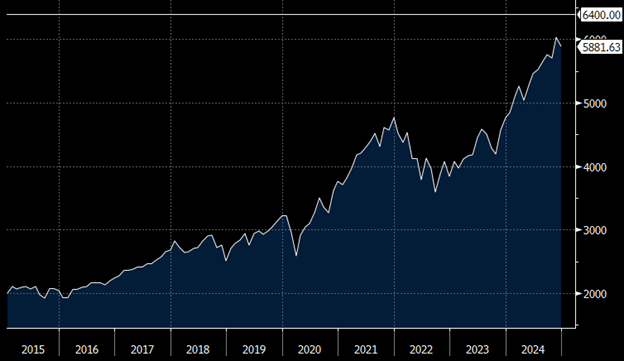
In context, that is a very good year after two consecutive years of greater than 20% market gains. So where is the inflection point? For the past two years market returns have been driven by multiple expansion. We break down stock market returns into two main categories. One is earnings growth, the ability of companies to increase their bottom line over time. A second is, will investors being willing to pay more for the same amount of earnings. Over the course of 2023 and 2024, the S&P 500 Index gained over 50%. Over 44% of this return (80%+), came from stocks getting more expensive, not from earnings growth.
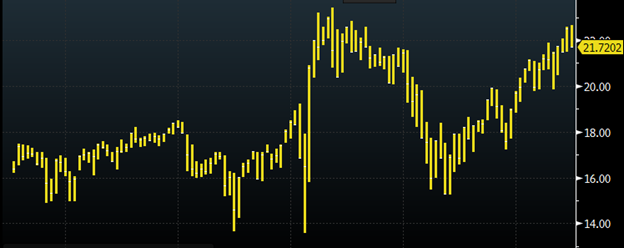
If our year-end target for 2025 is accurate and the consensus estimate for earnings growth in 2025 is also correct (11.5%), this will only be the fourth year in the past decade where earnings growth drove 100% or more of the market return. In fact, market returns for the past decade have been so strong, relative to earnings, that today we pay 33% more for the same amount of earnings verses ten years ago. We believe market returns, going forward, will be driven primarily by earnings growth and in some cases, earnings growth may outpace market returns.
As it pertains to non-US equities, consensus expects earnings growth of 4% across Europe, Japan and Australia along with 13% growth across Emerging Markets. We expect international markets to be up roughly in line with EPS growth estimates which is why we have a slight overweight to Emerging Markets and an underweight to develop markets outside the US (Europe & Japan).
FIXED INCOME
The Federal Reserve lowered their target for the Fed Funds Rate in December to a rage from 4.25% – 4.50%, the third straight meeting to close out 2024 with an interest rate cut. The 10-year benchmark treasury note had a yield of 4.57% and the 2-year note yielded 4.24%. The yield curve, starting with the shortest maturity issue (one month) all the way out to 30-year treasury bonds, ended 2024 between the range of 4.24%-4.88%, a 64 basis point range.
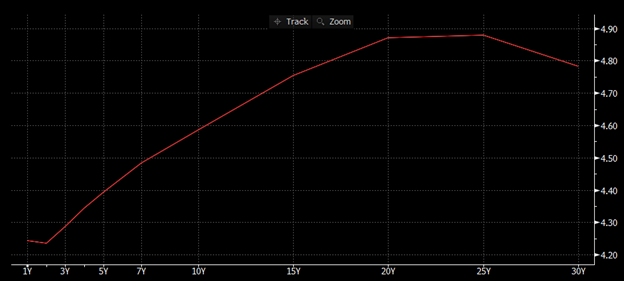
This is highly unusual. Typically, the yield curve is more upward sloping in order to compensate investors for taking on the price risk of holding a long maturity debt instrument. The yield curve is also a function of short-term rate expectations going all the way out to thirty years. Given how tight the yield range is across the curve, the market is essentially implying little to no change in the Fed Funds rate for the next thirty years.
At Custos, we expect the Fed to reduce rates one to two more times in 2025, which is roughly in line with consensus. We expect the 10-year and 2-year yield will finish the year at 4.06% and 3.75% respectively, down approximately 0.50% from year end 2024 levels. This would generate a 6-7% total return in core fixed income and a 5-6% return in investment grade municipal bonds. The Fed has told the market it would like to be able to bring short-term interest rates down out of what they consider restrictive monetary policy, however, inflation and a stable jobs market has prevented the Fed from lowering interest rates further. We believe inflation is at an inflection point in 2025 and will move decidedly lower or higher which will, in turn, drive Fed Reserve policy.
Corporate bond spreads, a measure of credit risk in the economy, are near the tightest in history. Despite the stress in commercial real estate, most acutely felt in the office sector, traditional credit has held up quite well. At this point, our view is that investment grade and high yield bonds are priced to perfection (which can limit long-term return potential), and we will avoid increasing exposure to these areas until a repricing occurs.
NEW ADMINISTRATION
As mentioned previously, the most glaring inflection point in 2025 will be the change to a new administration. This is a normal process that occurs every four to eight years, but it is hard not to recognize that in the modern era of US politics the difference in political agendas between the two parties has never been more drastic. By contrast, we were reminded with the recent passing of President Jimmy Carter, how dear of friends he was with Gerald Ford, the man he beat at the ballot box and ultimately replaced him as President. In doing so, Ford served a less than one term as president after assuming the office after Nixon stepped down. Nevertheless, President Ford’s son fulfilled his father’s promise to deliver the eulogy at Jimmy’s funeral, reading the eulogy Ford had prepared before his own passing. Times, they are “a-changing”, as they say. There is no question the agenda of the second Trump administration will be vastly different than the Biden administration, another inflection point the market and all of us will need to adjust to.
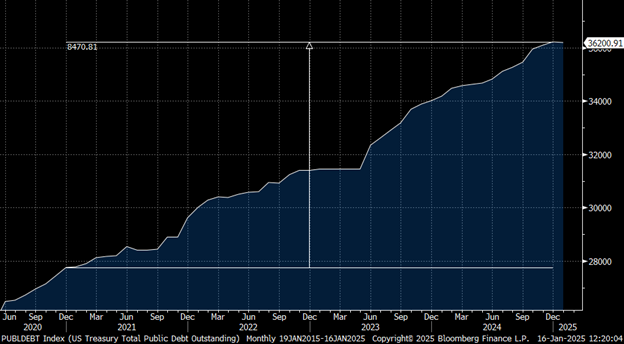
As it pertains to markets, at Custos, our focus will be on fiscal policy. Q4 2024 saw the single largest quarterly budget deficit in the history of the republic (outside of the pandemic) and that includes the Global Financial Crisis (GFC) in 2008/2009. We do not have available data for Q4 GDP, but for the twelve-month period ending September 2024, nominal GDP? (not adjusted for inflation) was up $1.4T and over the same period the US government ran a cumulative deficit of more than $1.8T. Since we are on the topic of politics, starting with the calendar year 2021 through Q3 2024, GDP increased $7.3T while US Treasury debt rose $8.5T (chart below). President Trump and some of his inter-circle have been very vocal about wanting to reduce or eliminate the federal deficit. While this is something the country needs desperately, it is often easier said than done. Even modest deficit reductions will force an adjustment, with the private sector having to shoulder the responsibility for growing the economy.
INFLATION
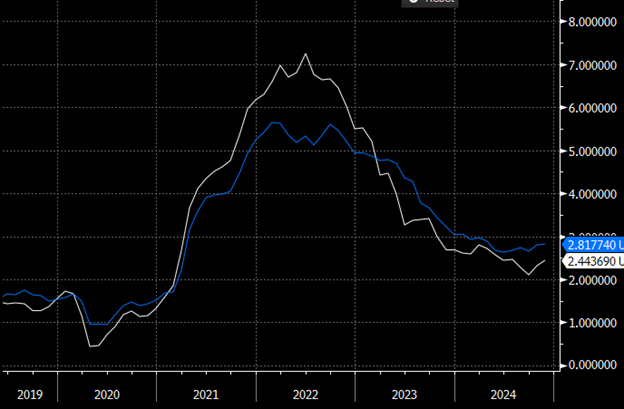
The Federal Reserves preferred measure for inflation, the Personal Consumption Expenditures (PCE) index, fell considerably in 2023 and was in the process of continued moderation in 2024 until around the time the Fed started cutting rates. Headline PCE nearly reached 2.0% year-over-year in August. Even Core PCE was on its way to the mid-2% range when monthly readings started to increase. We believe further rate cuts will require core PCE to resume a declining trend.
CONCLUSION
In summary, we expect 2025 to be a positive, albeit more normal year for equity markets returns verses the past two years of outsized returns. We expect core bonds and municipals to also have a good year with starting income yields at some of the highest levels in the past fifteen years. For diversified portfolios we expect returns of 6-8%, which would be well above the level of inflation expected this year. Inflation will be the key driver for the Fed policy this year and to a lesser extent the jobs market. Finally, we will be closely monitoring the policy agenda of the incoming administration and its impact on markets. From trade to fiscal policy, we expect a 180-degree shift from the previous administration.
To our clients, we thank you as always for your trust and we wish you and your family a happy and prosperous 2025.
The views expressed in this newsletter represent the opinion of Custos Family Office, a Registered Investment Adviser. This material is for informational purposes only. It does not constitute investment advice and is not intended as an endorsement of any specific investment or services. The information provided herein is obtained from sources believed to be reliable, but no representation or warranty is made as to its accuracy or completeness. Investing in equity securities involves risks, including the potential loss of principal. While equities may offer the potential for greater long-term growth than most debt securities, they generally have higher volatility. International investments may involve risk of capital loss from unfavorable fluctuation in currency values, from differences in generally accepted accounting principles, or from economic or political instability in other nations. Past performance is not indicative of future results. Investments are not a deposit of or guaranteed by a bank or any bank affiliate. Please notify Custos Family Office if there have been any changes to your financial situation or investment objectives or if you wish to impose or modify any reasonable restrictions on the management of your accounts through Custos Family Office.
